
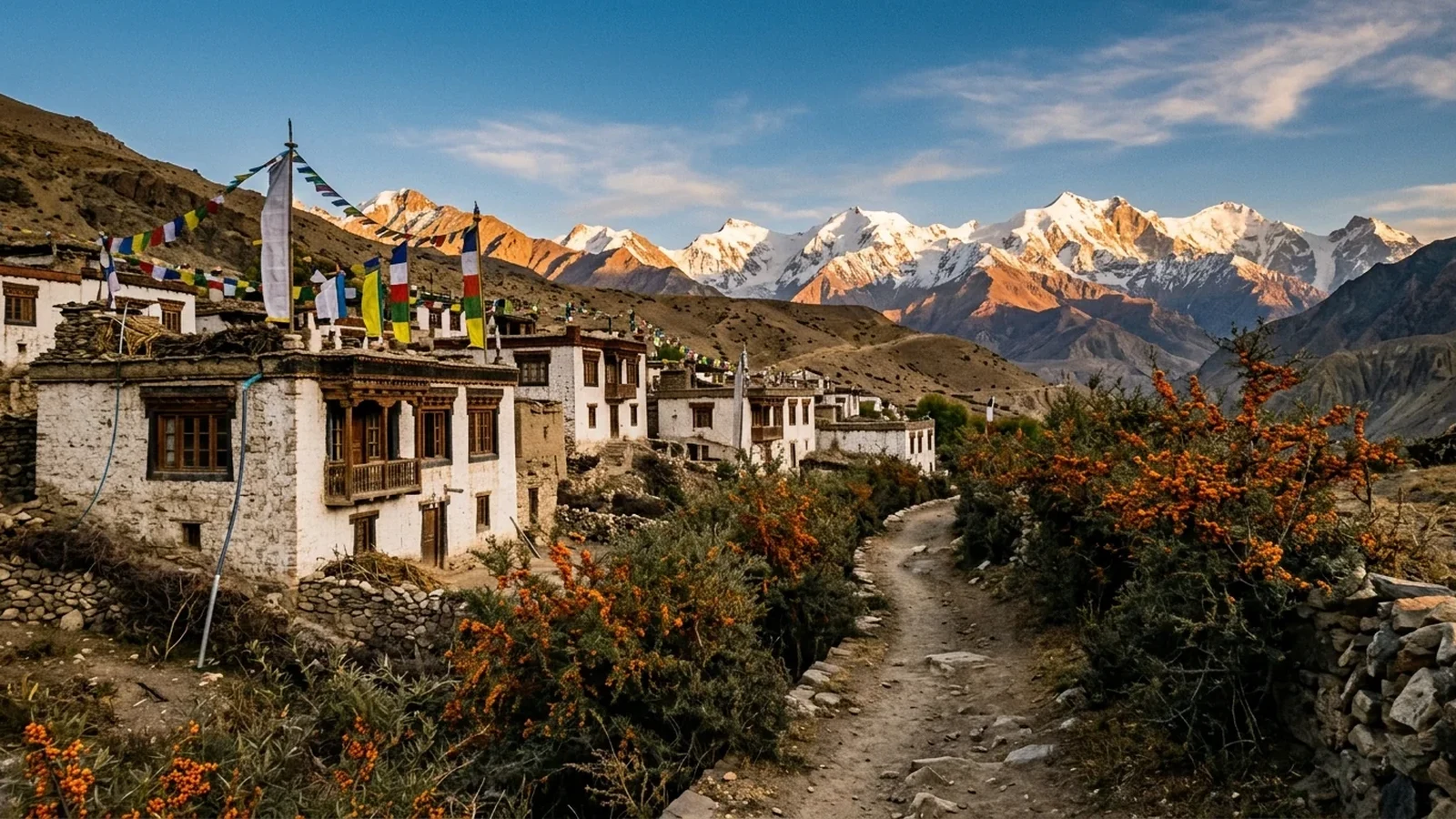
At 11,500 feet, where the air is thin and the earth is silver, a small orange berry glows against the grey mountain like a lantern. Ladakhis call it Tsermang. To the botanists it is Hippophae rhamnoides. To us, at Amberbio, it is Nature's Gold.
For centuries, the people of Ladakh have known what modern science is only now beginning to prove. The wild sea buckthorn that grows along the Indus and Zanskar riverbeds is not simply a plant. It is medicine. It is food. It is a way of holding on to health in a landscape that can feel unwelcoming to almost every other living thing.
In monasteries carved into cliff faces, monks brew a bright orange tea from its leaves before the long winter sets in. In the mud-plastered kitchens of Nubra, grandmothers press the berries into a thick, tart juice and hand it in tin cups to children with fevers. In the summer harvest, entire villages spread out across the thorny bushes with cloth sheets and long wooden sticks, gently coaxing berries down without wounding the branches.
A plant that shouldn't exist
Sea buckthorn thrives where almost nothing else does. Freezing winters, dry summers, saline soils, thin oxygen — conditions that would exhaust a lesser plant become its advantage. Its roots reach deep into the earth and fix nitrogen, quietly making the surrounding soil richer. In a place shaped by scarcity, it is the botanical equivalent of a small miracle.
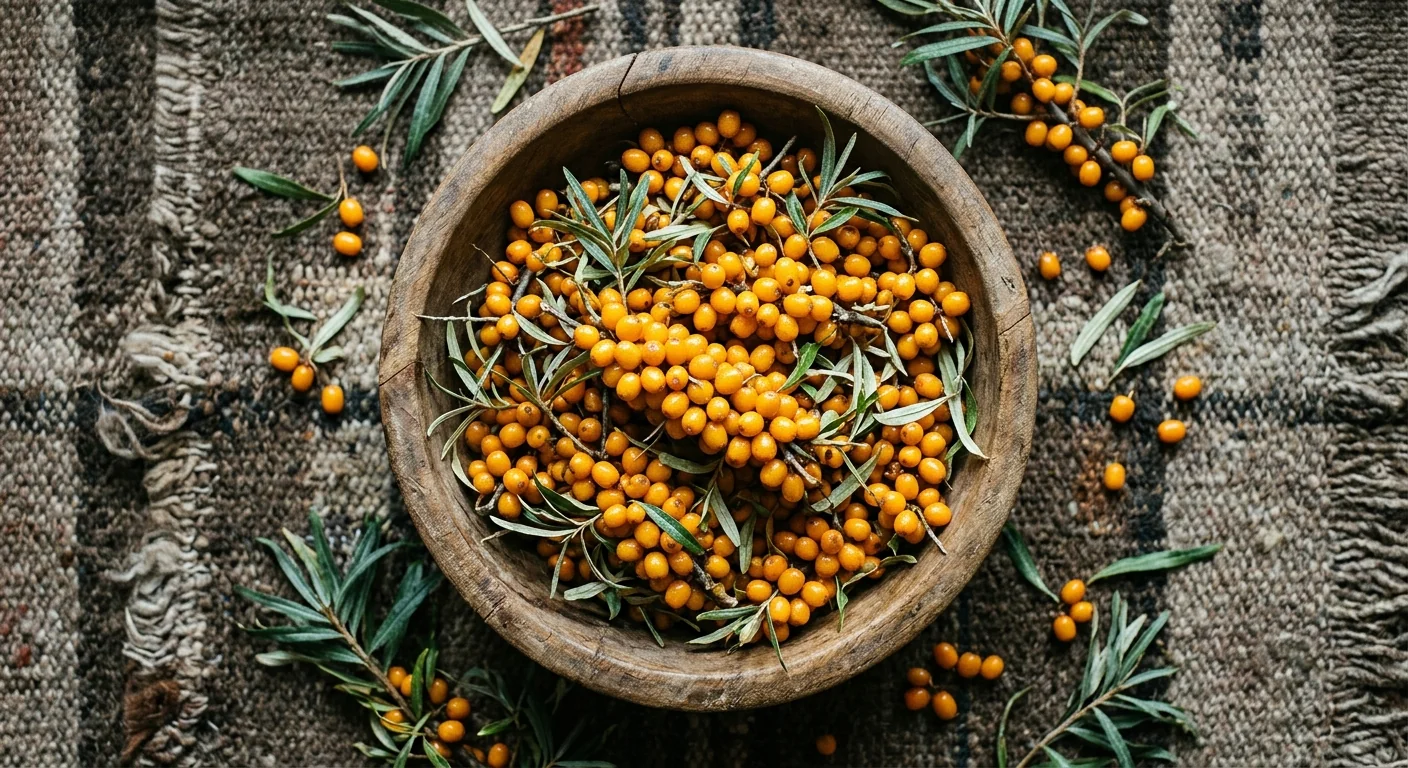
This resilience is exactly why the berry is so extraordinarily rich. To survive UV radiation at high altitude, it packs itself with antioxidants. To hold water through cold, it stores fatty acids most plants can only dream of — Omega-3, 6, 7 and 9, all in one small fruit. To keep its bright orange colour through frost, it carries carotenoids by the handful.
One handful of Ladakhi sea buckthorn contains more Vitamin C than 12 oranges, more Omega-7 than a bottle of macadamia oil, and over 190 bioactive compounds identified in modern labs.
At Amberbio, we do not add any of this. We simply do not take it away.
Bringing it out of the mountains — gently
Our promise from the beginning has been simple. We source directly from the small farming communities of Ladakh. We pay fair wages during harvest. We extract the oils using supercritical CO₂ and gently pasteurise the juice so nothing important is lost. We never add sugar, artificial colours or flavours — our juice contains only INS 202 (potassium sorbate, an FSSAI-approved preservative) at safe levels for shelf stability, and our oils and tisane are 100% botanical.
The bottle you hold at home is, as closely as we can manage, the same fruit that grows wild along the Indus. Nature's Gold — quietly, exactly as it was found.